
Case Study
Building up UK defence security with ‘critical minerals’ circular economy via 3D printing
Additive Manufacturing Solutions
Seven years ago, visionary engineer and prolific ideas-generator Rob Higham and his wife Katie decided to create a small specialist business to support their family. Today, they are expanding their vision strategically, exponentially and nationally with RedCAT support.
Since 2023, their original goal has evolved into a major innovative boost for Britain’s defence, aerospace and automotive industries at a time when vital exotic metal supplies are increasingly being compromised by global trade wars.
As Rob explains later, he believes the technologies his Burscough-based company is developing have the potential to solve a significant UK problem. Many authoritative figures agree with him.
Scaling-up a good idea
Their updated vision – which is fast becoming a reality – is to create an innovative manufacturing technology sector that recovers ‘critical minerals’ like titanium, grinds them into as fine metallic powders, and uses these as feedstocks to 3D-print extremely high-quality components.
In practise, it means that key parts from Britain’s older fast-jets can be recycled into the latest advanced aircraft rather than relying on newly-mined ‘rare earth’ imports from not-always-friendly foreign suppliers.
Big 3D oaks from little inspired ideas grow
In just 24-months, Additive Manufacturing Solutions has perfected the conversion of valuable parts from surplus RAF Tornados into ‘flying quality’ components for the next generation of high-performance Tempest fighters.
With RedCAT’s help, AMS has won the confidence of Government ministers, defence chiefs, plus Rolls Royce. It is also working on investment plans for tens of thousands of square feet of new manufacturing floor space, advanced equipment, plus research and training capabilities.
“The feedback from the Government has been overwhelming,” Rob says. “My ideas have been turned into products and contracts that meet real needs and demands, and that it solely down to an ambitious mindset change inspired by the RedCAT team.”
His only regret, he adds, is that it didn’t happen earlier!
Detailed teamwork
There are, of course, more factors behind AMS’ swift expansion.
Rob joined BAE after leaving school in Preston. He studied Motor Sports Engineering at the University of Central Lancashire before moving to Airbus in Bristol, Bremen and Broughton where he developed a broad understanding of powders, 3D-printing, and the dynamics of how the two go together.
Leaving Airbus in 2017, he started AMS with early funding from Innovate UK but continued work as a lecturer and head of the University of Bolton’s Centre for Advanced Manufacturing.
“In May 2022, I finally quit the day job to ‘have a go’ with AMS for six months … and then another 12 months. Now, in 2025, we have multi-year aerospace product contracts for research and have produced ‘flying parts’,” he says.
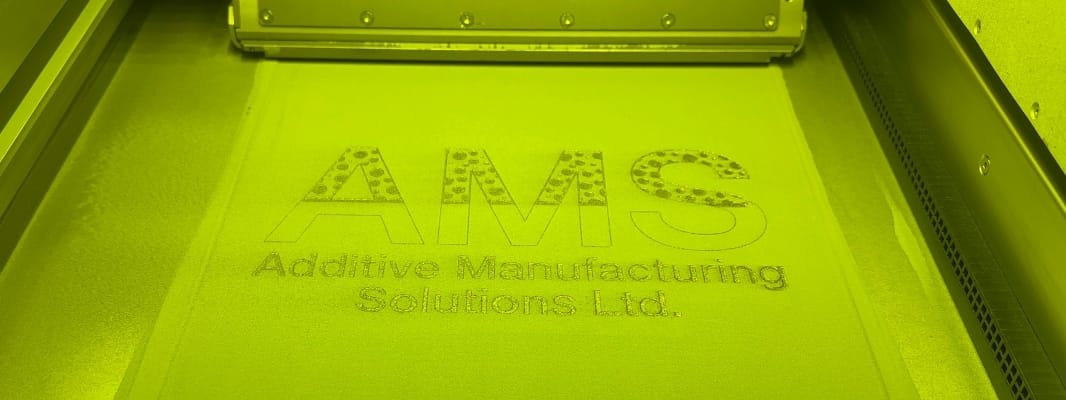
3D printing with metallic powders progressively welds thousands of powder layers tens of microns thick one on top of the other to build high-integrity structures. In AMS’s case, aluminium and now titanium are carefully-prepared feedstocks. The company has its first SLM280 machine and will soon install more (see later).
Human factor
Well-known as an expert in a very niche field, Rob has always generated challenging technical ideas – good, bad, and indifferent, a quality that perhaps makes him a good engineer, he quips.
Under the banner of “Redefining industry, one layer at a time”, AMS is committed to developing technologies that make UK manufacturing more efficient and cost-effective with minimum waste.
“But building a business is a very lonely place, especially for an enterprise business owner like me,” he adds. “Having RedCAT people around to fight our corner on rainy days gave us confidence.”
“When we met the RedCAT team, they immediately showed us what AMS had created could become and how to get there. They gave us a super-clear picture of what we do, when and how. We are still on our RedCAT journey. But we are ready to move into the real world of global manufacturing.”
Commercialisation journey
The RedCAT team’s methodology bridges the notorious ‘valley-of-death’ commercialisation gap that defeats many good innovators.
“RedCAT’s technical guidance and early funding support was crucial to commercialise our particular speciality. Their multi-pronged team approach involves creating an early comprehensive plan and step-by-step guidance through that plan.
“They quickly became part of our team without the worry of extra salaries. Their wrap-around support included governance and finance through RedCAT”.
“Fractional CFOs or financial directors providing CFO-level services on a part-time or contractual basis make a lot of sense. However, for a full picture to design and develop AMS for growth we needed RedCAT support.”
Embedded RedCAT specialist
Part of RedCAT’s ‘post-prototype-model-to-finished-products-retailer-shelves’ commercialisation journey involves expert input from embedded specialists.
AMS’ expert was Ged Heffernan, RedCAT’s resident physicist, scientist, plus technology and manufacturing lead who ensures innovations scale effectively and add value in competitive markets.
Ged own career also included high-level posts with Rolls Royce and BAE and the two teams – AMS and RedCAT – spoke the same language and gelled quickly. As Rob notes, “Ged knows his technical, theoretic and academic onions inside out and has been extremely supportive throughout. Everything he does solves a problem, creates an opportunity, or adds value.”
Positive outcomes
Ged and RedCAT are helping AMS to develop a new method of 3D printing with recycled metallic powders to make parts quicker and cheaper with no waste.
“Ged’s ability to turn good technical ideas into commercial strategies with a blend of business, government and leadership has been such a high-value addition. Many types of business support are available but none show the motivation, interest and support we found with Ged. Ged feels and talks like an AMS founder. It has been a pleasure to have him on the team.”
National problem, North of England solution, UK security
Rob believes Britain faces a future materials resilience problem – being able to meet its critical minerals needs without relying on third-party nations. Part of the solution is recycling them into high-performance and high-temperature technology components at scale and economically.
Having impressed senior politicians once, Rob is now lobbying the Government hard to mandate critical mineral ‘air recycling’ from waste electronics, batteries, and old parts, to reduce mining, enhance supply security, and minimise environmental impacts.
“This is a real commercial opportunity with national security at its heart,” he explains.
Heart of Britain
“I am an unashamed Lancashire-ite. I’m also British,” he adds. “I want our new technologies to operate here.” But this comes with wider caveats.
“Simply chasing money would irradicate our values. Our focus is not just profit. Scaling-up AMS is about good honest long-term planning. If we don’t do it properly, the business will not grow. Our greater aim is to create capacity for a new strategic UK industry. RedCAT understands this.
“What we are actually doing is creating a new rule book changing how the world thinks about manufacturing to shorten supply delays, cut rising costs and embrace technology’s benefits.”
Powder and people
Powders are produced externally. AMS brings together parts, powder and training. The trick is to develop powders in harmony with the product. Powder is dynamic – it changes continuously.
The company currently has eight skilled staff members and needs people with a deep understanding of feedstock, which is why it has its own in-house training academy.
Strategic Command Commendation Certificate
In March 2025, the Ministry of Defence’s Strategic Chief of Defence Logistics and Support Commendations event commended companies working to support UK armed forces front lines. The Tornado 2 Tempest project received that commendation from Vice Admiral Andy Kyte at a celebration event in London.
Tornado 2 Tempest team
The project proved AMS’ concept of reusing Tornado aircraft parts in Tempest. Specifically, titanium atomised into powders was used to 3D-print the nose cone for the Rolls-Royce Orpheus engine Tempest uses.
This achievement was welcomed strongly by Vice Admiral Kyte, the current Chief of Defence Logistics and Support (CDLS) who heads up MoD procurement.
Building the future one layer at a time
Future AMS research will explore how its Laser Powder Bed Fusion (LPBF), aka Direct Metal Laser Sintering (DMLS) or Selective Laser Melting (SLM), 3D printers can be used more effectively.
This already has one enthusiastic devotee. Rob and Katie’s son, Leo, is already planning an engineering career in the family business. He is particularly interested in the full potential of the SLM 280.
Or as he calls it at the age of five, the “fireworks machine”!
